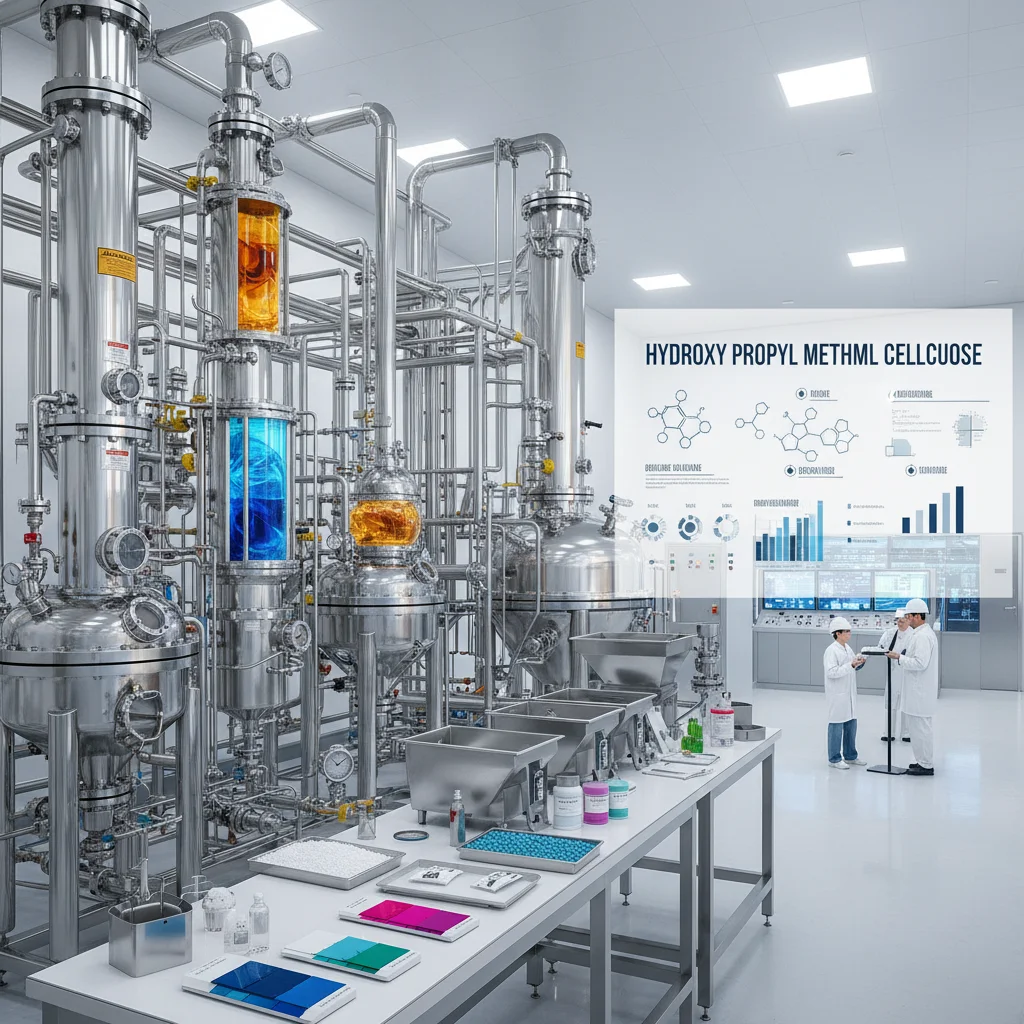
When evaluating high-performance thickeners for industrial formulations, the selection of a reliable source for cellulose ethers often determines the final product's stability and consistency. Many procurement managers struggle to balance the need for precise viscosity control with the requirement for batch-to-batch uniformity, especially in sensitive pharmaceutical and food-grade applications where deviations can lead to significant production losses.
The technical efficacy of Hydroxypropyl Methylcellulose (HPMC) lies in its non-ionic nature and its ability to form stable colloidal solutions. For manufacturers operating within the specialized chemical sector, understanding the interplay between methoxy and hydroxypropyl content is essential. These chemical parameters directly influence water retention and film-forming capabilities, which are critical for the structural integrity of complex chemical mixtures.
By analyzing the technical specifications and procurement benchmarks, this guide provides a professional framework for identifying high-purity hydroxypropyl methylcellulose suppliers. We will examine how the precise etherification of natural polymer cellulose transforms raw materials into an indispensable agent for thickening and emulsifying across global industrial sectors.


Hydroxypropyl Methylcellulose (HPMC) is a high-purity, non-ionic cellulose ether synthesized through the precise etherification of natural polymer cellulose. This process results in a white, odorless, and non-toxic powder capable of creating stable colloidal solutions. Its molecular structure allows it to act as a multifunctional agent, providing essential thickening, dispersing, and emulsifying properties that are critical for maintaining the homogeneity of complex industrial mixtures.
The versatility of HPMC stems from its ability to be tailored during the synthesis phase. By adjusting the substitution levels of methoxy and hydroxypropyl groups, the chemical properties of the resulting powder can be optimized for specific environmental conditions, such as varying pH levels or temperature ranges. This chemical flexibility ensures that the product remains stable and effective across a wide array of pharmaceutical and food-processing applications.
The performance of HPMC is dictated by several key technical metrics. Viscosity, ranging from 17,000 to 200,000 mPa.s, is the primary indicator of the product's thickening power. Alongside this, the methoxy content (19% - 30%) and hydroxypropyl content (4% - 12%) define the solubility and thermal gelation properties of the polymer, ensuring it behaves predictably during the manufacturing process.
The gel temperature, typically maintained between 60°C and 70°C, is the most critical factor for controlled-release pharmaceutical applications, as it determines the exact point where the solution transitions to a gel state, thereby regulating the delivery rate of active ingredients.
Furthermore, purity levels are monitored through ash content (≤ 3%) and moisture content (≤ 5%). These parameters prevent premature degradation and ensure that the HPMC does not introduce unwanted impurities into food-grade or medical-grade formulations. High-purity composition is the only way to guarantee reliable, batch-to-batch performance in highly sensitive industrial environments.
Implementing premium HPMC into a production line offers significant advantages over standard cellulose ethers. The primary value lies in superior water retention, which prevents premature drying in coatings and improves the workability of pharmaceutical gel skeletons. This efficiency reduces waste and ensures that the final structural integrity of the product meets global quality benchmarks.
From an operational perspective, the ability to customize viscosity levels allows manufacturers to optimize flow characteristics, reducing the energy required for mixing and processing. When integrated correctly, HPMC enhances the stability of emulsions, preventing phase separation in daily chemical products such as high-end detergents and cosmetics.
In the pharmaceutical sector, HPMC is utilized as a hydrophilic gel skeleton and a pore-causing agent. Its primary role is the development of sustained-release preparations, where it controls the diffusion of drugs to ensure a steady therapeutic dose over time. This specialized application requires the highest grade of purity to avoid any adverse chemical reactions with active pharmaceutical ingredients (APIs).
Within food processing and daily chemicals, HPMC serves as a versatile additive for adhesion and emulsification. In the production of toothpaste and premium cosmetics, it provides the necessary consistency and viscosity that consumers associate with high-quality products. Its non-toxic and tasteless nature makes it an ideal choice for ingredients that come into direct contact with human skin or are ingested.
The evolution of etherification technology is moving toward more precise molecular weight distribution. By utilizing cutting-edge synthesis methods, it is becoming possible to create HPMC with even narrower viscosity ranges, allowing for unprecedented levels of control in high-precision industrial coatings and medical capsules.
Environmental sustainability is also driving innovation in the sourcing of natural polymer cellulose. There is an increasing focus on reducing the chemical footprint of the etherification process while maintaining the high purity required for food and pharma grades. This shift is likely to result in "greener" cellulose ethers that offer the same performance benchmarks with lower environmental impact.
Additionally, the integration of AI-driven quality control in the manufacturing process is expected to further eliminate batch-to-batch variability. By monitoring the methoxy and hydroxypropyl substitution levels in real-time, suppliers can ensure that every shipment adheres to the exact technical specifications requested by the end-user.
One of the primary challenges when integrating HPMC into a new formula is managing the dissolution process to avoid the formation of lumps. This is typically solved by utilizing high-shear mixing equipment or by pre-dispersing the powder in a non-solvent before adding water. Proper hydration is essential to unlock the full thickening potential of the polymer.
Another common issue is the compatibility of HPMC with other electrolytes or surfactants in the mixture. If the pH value shifts outside the 5.0 - 8.0 range, the stability of the colloidal solution may be compromised. Technical support from the supplier is often necessary to optimize the formula stabilization and ensure the polymer does not precipitate out of the solution.
Finally, managing the cost-to-performance ratio requires a precise selection of the viscosity grade. Using a viscosity that is too high can increase production time due to slow mixing, while a grade that is too low may fail to provide the required structural stability. The following table provides a selection guide based on typical industrial requirements.
| Application Sector | Recommended Viscosity | Critical Property | Primary Function |
|---|---|---|---|
| Pharmaceuticals | High (100k+) | Gel Temp 60-70°C | Sustained Release |
| Food Processing | Medium (50k-100k) | Non-toxic/Odorless | Emulsification |
| Daily Chemicals | Medium (30k-60k) | Film Forming | Viscosity Control |
| Industrial Coatings | Low (17k-30k) | Water Retention | Thickening Agent |
| Cosmetics | Medium (40k-80k) | High Purity | Texture Stability |
| Detergents | Low (20k-40k) | PH Stability | Dispersion Agent |
In pharmaceutical applications, HPMC functions primarily as a hydrophilic gel skeleton material, a pore-causing agent, and a coating agent. Its most critical use is in the development of sustained-release preparations, where it controls the rate of drug delivery by forming a gel layer that regulates the diffusion of the active ingredient.
HPMC acts as a multifunctional additive providing adhesion, emulsification, film formation, and thickening. It improves the overall texture and stability of processed foods, ensuring that ingredients remain evenly dispersed and that the product maintains its consistency during storage and transport.
Yes, the daily chemical grade of HPMC is specifically engineered for use in toothpaste, cosmetics, and detergents. It is used to improve the rheological properties of these products, providing the smooth consistency and stability required for high-end personal care items.
Viscosity is primarily influenced by the degree of substitution—specifically the methoxy and hydroxypropyl content—and the molecular weight of the cellulose polymer. These factors are determined during the etherification process and dictate how the polymer interacts with water to create a thickened solution.
The gel temperature (typically 60-70°C) is the point at which the HPMC solution transitions from a liquid to a gel state. This thermal property is critical for pharmaceutical manufacturers to control the release rate of drugs and for industrial users to manage the stability of coatings during heat treatment.
Absolutely. HPMC is a non-toxic, odorless, and tasteless cellulose ether. Because it is synthesized from natural polymer cellulose and meets rigorous purity standards, it is globally approved for use in food, medicine, and personal care products.
Selecting the right Hydroxypropyl Methylcellulose requires a deep understanding of how chemical parameters like viscosity, gel temperature, and substitution levels impact the final product's performance. Whether used as a sustained-release agent in pharmaceuticals or a stabilizer in daily chemicals, high-purity HPMC provides the structural integrity and consistency necessary to meet global quality benchmarks.
For organizations seeking to optimize their production yields and ensure formulation stability, partnering with a technical expert in cellulose ethers is essential. If you are looking for high-purity HPMC tailored to your specific industrial requirements, we invite you to explore the technical capabilities and product range at https://www.tjhpmc.com.

Hit enter to search or ESC to close