Hydroxypropyl methylcellulose (HPMC) E5 is a versatile cellulose ether derivative widely utilized across diverse industries, from pharmaceuticals and food to construction and personal care. Its unique properties, stemming from its controlled molecular weight and substitution pattern, make it an essential component in numerous formulations and applications. Understanding HPMC E5 is crucial for professionals seeking optimized performance, enhanced product stability, and innovative solutions in their respective fields.
Globally, the demand for HPMC E5 is continuously increasing, driven by a growing emphasis on water-based formulations, sustainable materials, and specialized functionalities. This demand is particularly pronounced in emerging economies experiencing rapid industrialization and infrastructural development. The market is estimated to be worth billions, with a consistent growth rate projected for the coming years due to its biocompatibility and wide range of applications.
HPMC E5 effectively addresses challenges related to viscosity control, film formation, water retention, and thermal stability. Its ability to act as a thickener, binder, film-former, and protective colloid makes it an irreplaceable ingredient in many modern industrial processes and consumer products. This has led to extensive research and development centered around optimizing its production and exploring novel applications for this remarkable polymer.
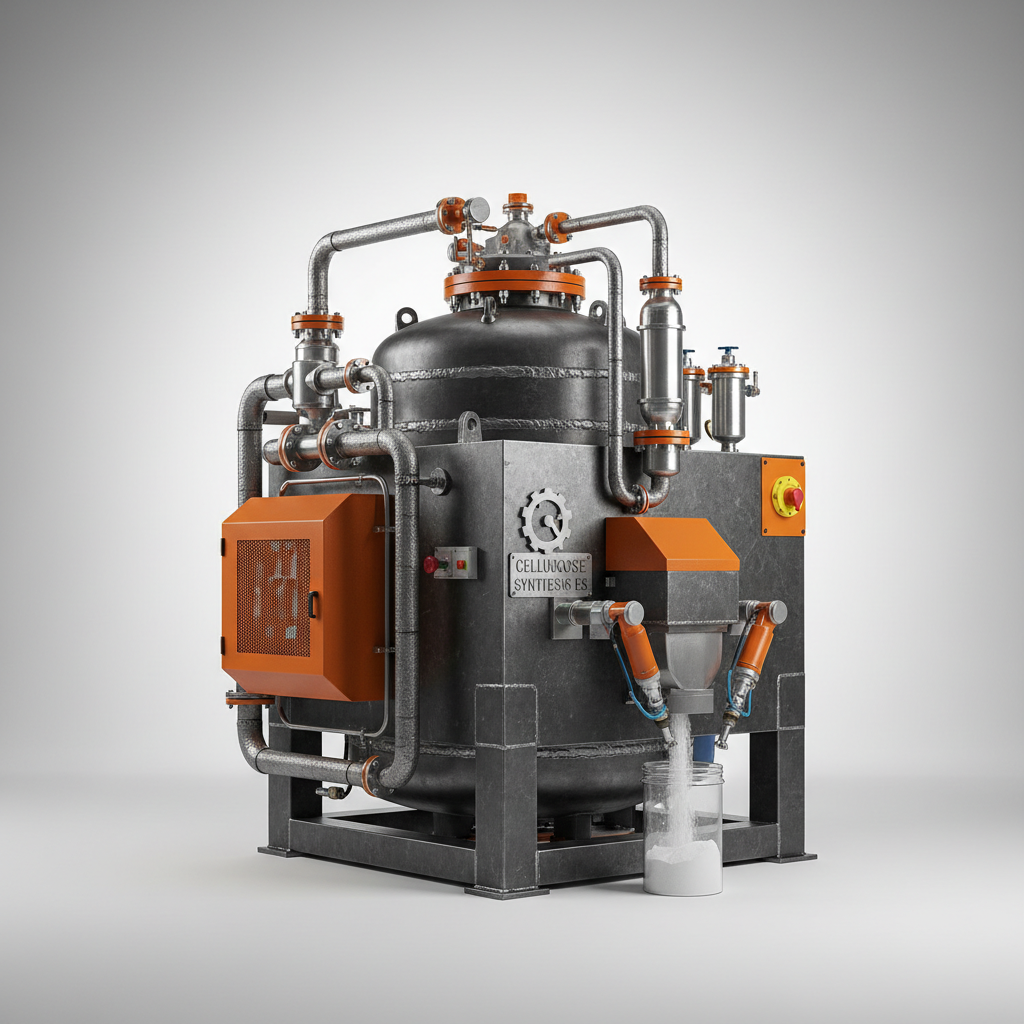
Introduction to Hydroxypropyl Methylcellulose E5
Hydroxypropyl methylcellulose E5 is a non-ionic cellulose ether, chemically modified to impart specific properties crucial for various applications. The "E5" designation refers to its viscosity range, indicating its thickening capabilities. It's derived from cellulose, a naturally abundant polymer found in plants, making it a sustainable and renewable resource. hydroxypropyl methylcellulose e5 is favoured due to its purity and consistent performance.
Its production involves a series of chemical modifications to cellulose, including etherification with methyl and hydroxypropyl groups. These modifications control the polymer's solubility, viscosity, and gelation characteristics, making it adaptable to a wide range of formulations. The resulting product is a white to off-white powder, odorless and tasteless, offering excellent compatibility with many other ingredients.
Global Relevance and Industrial Applications
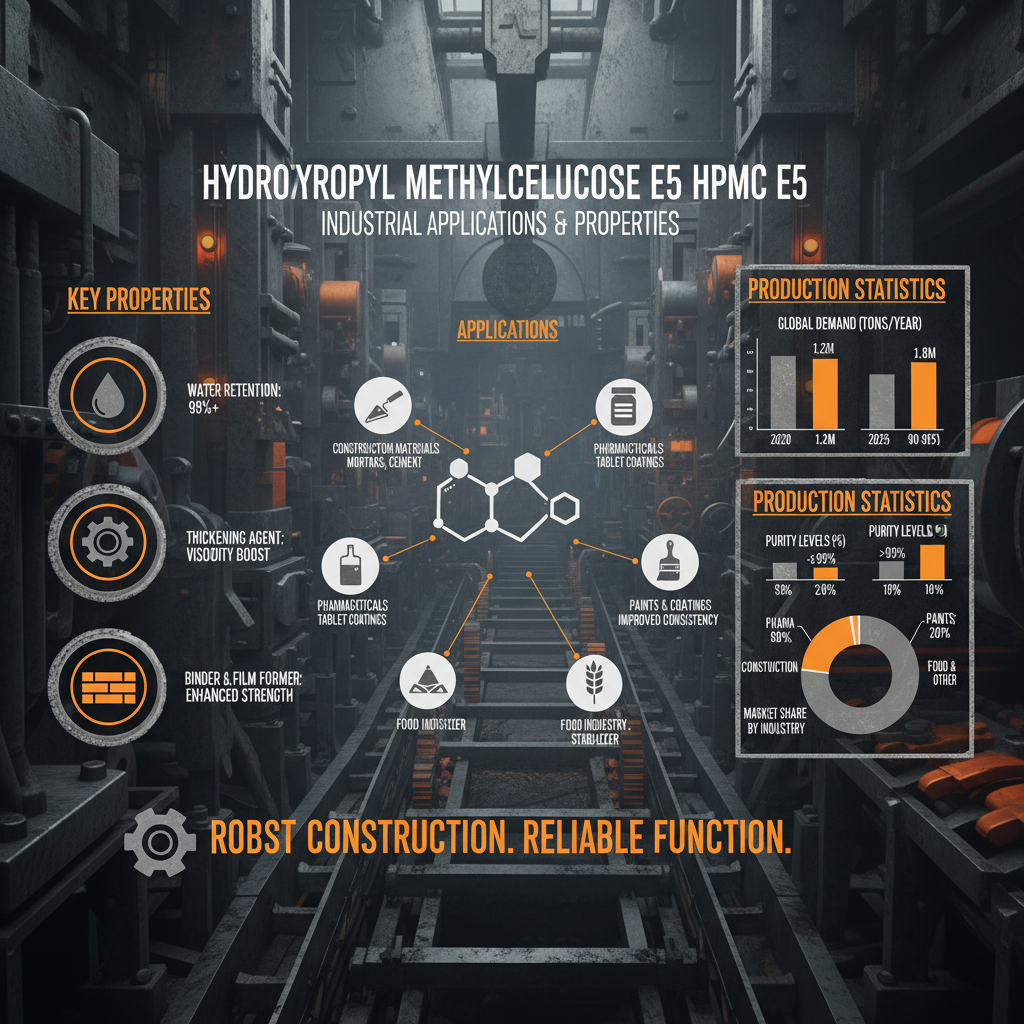
The global market for cellulose ethers, including HPMC E5, is substantial and continually expanding. According to industry reports, the market is valued in the billions of dollars, with a projected compound annual growth rate (CAGR) of around 6-8% over the next decade. This growth is driven by increasing demand from key industries like construction, pharmaceuticals, food, and personal care. hydroxypropyl methylcellulose e5 plays a critical role in each of these sectors.
In the construction industry, HPMC E5 is used as a vital component in cement-based mortars, tile adhesives, and gypsum plasters. It improves workability, water retention, and adhesion, resulting in enhanced construction quality and reduced cracking. In pharmaceuticals, it serves as a binder, film-former, and controlled-release agent in tablets, capsules, and topical formulations.
The food industry utilizes HPMC E5 as a thickener, stabilizer, emulsifier, and film-former in products like sauces, dressings, desserts, and bakery goods. It ensures consistent texture, prevents syneresis, and extends shelf life. Finally, in personal care products, it contributes to viscosity control, emulsion stability, and film-forming properties in lotions, creams, shampoos, and conditioners.
Defining Hydroxypropyl Methylcellulose E5
Hydroxypropyl methylcellulose E5 is a semi-synthetic polymer derived from cellulose, a naturally occurring polysaccharide. It is produced through a series of chemical modifications, primarily methylation and hydroxypropylation, which alter the cellulose's properties to enhance its solubility and functionality. These modifications create a polymer chain with varying degrees of substitution, which ultimately determine the viscosity and characteristics of the final product.
The “E5” designation specifically refers to the viscosity grade of the HPMC. A higher number indicates a higher viscosity when measured under standardized conditions. Viscosity is a critical parameter as it dictates the thickening and water-retention properties, making it essential to select the appropriate grade for a specific application. hydroxypropyl methylcellulose e5 E5 offers a good balance between thickening and processability.
Crucially, HPMC E5 is biocompatible and generally recognized as safe (GRAS) by regulatory bodies like the FDA, making it suitable for use in food, pharmaceutical, and cosmetic applications. Its non-ionic nature ensures compatibility with a wide range of ingredients, including both anionic and cationic substances, providing formulators with significant flexibility.
Key Properties of Hydroxypropyl Methylcellulose E5
Several key properties define the efficacy of HPMC E5. These include its water solubility, thickening ability, film-forming capacity, thermal gelation properties, and chemical stability. Each contributes to its versatility across diverse industries.
Water solubility allows HPMC E5 to easily dissolve in cold water, forming clear, viscous solutions. This makes it ideal for creating aqueous-based formulations. Its thickening ability arises from its high molecular weight and ability to increase the viscosity of solutions even at low concentrations.
Performance Metrics of Hydroxypropyl Methylcellulose E5
Global Applications and Use Cases
HPMC E5 finds widespread applications globally. In the construction sector, particularly in regions experiencing rapid urbanization such as Southeast Asia and Africa, it’s used extensively in dry-mix mortars and tile adhesives, improving their workability and preventing cracking.
Within the pharmaceutical industry, HPMC E5 is critical in the development of controlled-release drug formulations, particularly in countries with growing healthcare needs like India and Brazil. This ensures sustained drug delivery, improving patient compliance and therapeutic outcomes. Its use in topical creams and ointments is also prevalent worldwide.
The food industry leverages HPMC E5 globally for stabilizing emulsions in salad dressings and sauces, improving the texture of baked goods, and enhancing the mouthfeel of dairy products. Its ability to maintain product consistency is crucial for large-scale food production in developed nations like the US and Europe.
Advantages and Long-Term Value
The advantages of using HPMC E5 are multifaceted. Beyond its technical properties, it offers cost-effectiveness, sustainability, and ease of handling. Compared to some synthetic polymers, HPMC E5 is derived from a renewable resource (cellulose), reducing its environmental impact. It also offers excellent batch-to-batch consistency, ensuring reliable performance and reducing formulation challenges.
Long-term value stems from the improved product performance and extended shelf life it provides. In construction, enhanced durability reduces maintenance costs and increases the lifespan of structures. In pharmaceuticals, controlled-release formulations improve patient outcomes and reduce healthcare burdens. These factors contribute to significant economic and societal benefits.
Future Trends and Innovations
Future trends point towards increasing demand for bio-based and sustainable polymers, positioning HPMC E5 for continued growth. Ongoing research focuses on tailoring its properties through advanced modification techniques to meet specific application needs. For instance, researchers are exploring methods to enhance its thermal stability and resistance to enzymatic degradation.
The integration of nanotechnology with HPMC E5 is another promising area, potentially leading to the development of novel drug delivery systems and high-performance construction materials. Additionally, advancements in manufacturing processes aim to reduce production costs and minimize environmental impact, further enhancing its appeal.
Sustainability initiatives and the move toward circular economies are also driving innovation. Exploration into utilizing waste cellulose sources for HPMC E5 production would create a closed-loop system, reducing reliance on virgin materials and minimizing waste.
Summary of HPMC E5 Performance Factors
| Application Area |
Key Performance Indicator |
HPMC E5 Contribution |
Performance Score (1-10) |
| Construction Mortars |
Workability |
Improves plasticity and ease of application. |
9 |
| Pharmaceutical Tablets |
Binding Strength |
Enhances tablet cohesion and prevents crumbling. |
8 |
| Food Sauces |
Viscosity Control |
Provides desired thickness and texture. |
7 |
| Cosmetic Lotions |
Emulsion Stability |
Prevents separation of oil and water phases. |
6 |
| Dry-Mix Mortars |
Water Retention |
Maintains workability during application. |
10 |
| Controlled Release Drugs |
Drug Release Profile |
Regulates drug release rate for sustained effect. |
9 |
FAQS
HPMC E5 offers a superior balance of properties including excellent water solubility, thermal gelation, and film-forming capabilities. Compared to other cellulose ethers like methylcellulose (MC) or carboxymethyl cellulose (CMC), HPMC E5 generally exhibits better thermal stability and a more predictable gelation behavior, making it ideal for applications requiring precise control over viscosity and texture.
The viscosity grade, designated by the number (e.g., E5), directly correlates to the thickening power of the polymer. Higher viscosity grades provide greater thickening at the same concentration, impacting the flow properties of the formulation. Selecting the correct viscosity grade is crucial; too low, and you won’t achieve the desired texture, too high, and processing may become difficult. HPMC E5 offers a good balance for a wide range of applications.
Yes, HPMC E5 is generally compatible with a wide array of excipients and ingredients, due to its non-ionic nature. It exhibits good compatibility with both anionic and cationic substances, offering flexibility in formulation design. However, compatibility testing is always recommended, particularly with highly charged or reactive compounds, to ensure there are no unexpected interactions.
HPMC E5 should be stored in a cool, dry place, away from direct sunlight and moisture. Exposure to humidity can cause clumping and reduce its solubility. It is also recommended to keep the container tightly closed to prevent contamination. When stored properly, HPMC E5 typically has a shelf life of several years.
HPMC E5 is generally considered safe for handling, as it is non-toxic and non-irritating. However, as with any fine powder, it’s recommended to avoid inhaling the dust. Using a dust mask during handling is advised, and eye protection is also recommended to prevent irritation. Refer to the Material Safety Data Sheet (MSDS) for detailed safety information.
While HPMC E5 itself is derived from a natural source (cellulose), its production involves chemical modifications that may not align with strict organic certification standards. However, it is often permitted in formulations labeled as “natural” or “naturally derived” due to its overall biocompatibility and low toxicity. Checking with relevant organic certifying bodies is always recommended.
Conclusion
In summary, hydroxypropyl methylcellulose E5 is a remarkably versatile polymer with a wide spectrum of applications across diverse industries. Its unique combination of properties – including thickening, film-forming, water retention, and thermal gelation – make it an invaluable ingredient in countless formulations. The increasing demand for sustainable, bio-based materials further solidifies its long-term viability and importance.
Looking ahead, continued innovation in HPMC E5 production and application will unlock even greater potential. Research into tailored modifications, nanotechnology integration, and sustainable sourcing will drive its evolution, addressing emerging challenges and fostering new opportunities. To learn more about hydroxypropyl methylcellulose e5 and its potential for your specific needs, visit our website today.